

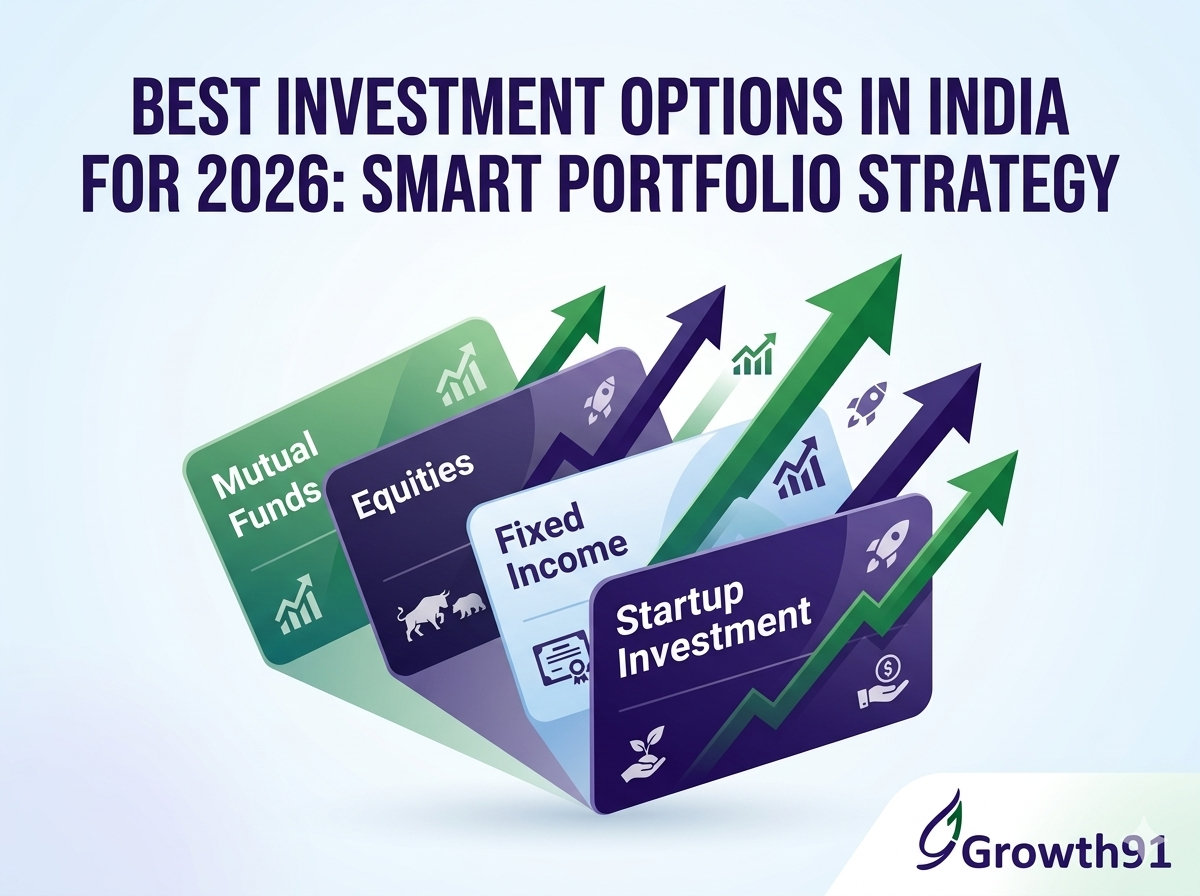
Looking for the best investment options in India for 2026 can feel overwhelming. Every day, you see new ideas on social media, new funds claim they will “beat the market,” and friends share different strategies—fixed deposits one day, real estate the next, and startups all the time. The real question isn’t “Which one investment is best?” It’s “How do I build a portfolio that can handle different situations?”
In 2026, India’s investment landscape is becoming more accessible and more competitive at the same time. Digital platforms make investing easier, sectors evolve faster, and risk shows up in new ways (like higher volatility in certain themes). That’s why a smart portfolio strategy matters more than ever. It should aim for balance: some parts should protect your capital, some parts should grow steadily, and a small portion can target higher growth opportunities.
In this guide, we’ll cover the most practical investment options in India for 2026, the role of diversification, and how you can include startup investing without putting your entire future on one bet.
Why 2026 is a Pivotal Year for Indian Investors
Economic and Regulatory Tailwinds
A key reason 2026 stands out is that more people are investing with clearer rules and better access. While no year is risk-free, supportive trends often make long-term planning easier.
Here are a few tailwinds that can matter for retail investors:
- More structured market access through regulated platforms
- Growing awareness of index funds and diversification
- Continued focus on transparency in financial products
- Faster growth cycles for technology and innovation
Even so, the smart approach is still the same: don’t guess. Understand your risk tolerance, your time horizon, and what you’re investing in.
Shift from Traditional to Diversified Portfolios
Many investors start with “safe” choices, like fixed deposits or property. Those can still have a place, but the modern portfolio mindset is broader.
Instead of choosing one category, think in layers:
- A base layer for stability and compounding
- A growth layer for long-term wealth creation
- An opportunity layer for higher-risk, higher-potential bets
This is where the idea of a smart portfolio strategy really clicks: you’re not reacting to headlines—you’re building with intention.
Core Safeguard Investments for Stability
Fixed Deposits and High-Quality Debt Instruments
If you’re asking what should anchor a portfolio, start with stability. Fixed deposits and high-quality debt instruments are commonly used for:
- Capital preservation
- Liquidity needs (money you may need within a shorter window)
- Managing volatility in the rest of your portfolio
A helpful way to decide: match the investment to your timeline. If you may need funds in 1–3 years, debt instruments can often be more suitable than equity-heavy strategies.
Blue-Chip Indian Equities and Index Funds
For long-term goals, equities usually play a stronger role than purely fixed-return products. A practical starting point is blue-chip stocks and index funds, because they spread your exposure and reduce the risk of relying on one company’s performance.
In 2026, many investors keep a core like this:
- Index funds or diversified large-cap mutual funds
- Systematic investment approach (SIP-style consistency)
- Enough staying power to ride out short-term market moves
The goal isn’t to “predict” the market. The goal is to keep investing through different market phases so compounding can do its work.
Growth-Oriented Equity and Sector Bets
Sectoral and Thematic Funds
Not all growth happens in the same place. In India, thematic investing often targets sectors like technology, renewable energy, digital financial services, and healthcare innovation. The advantage is focused exposure; the trade-off is higher volatility.
A simple rule can help: thematic funds should be sized as a growth sleeve, not the entire portfolio. If your portfolio becomes too theme-heavy, one underperforming sector can dominate your returns.
Mid-Cap and Selected Small-Cap Opportunities
Mid-cap and small-cap segments can offer higher growth potential, but they can also move sharply. If you consider them:
- Avoid concentration in just a few names
- Diversify within the category
- Review periodically, not emotionally
Position sizing matters here. A smart portfolio strategy doesn’t try to “go all-in” on every opportunity—it calibrates risk.
Alternative & High-Growth Investments in 2026
Startup Investing and Private Market Opportunities
This is the section many investors find exciting—and also the one that needs the most discipline.
Startup investing can be a way to participate in innovation, but it’s very different from public markets. You may face long timelines, limited liquidity, and more uncertainty around outcomes. That’s why many investors treat it like an opportunity layer, carefully sized inside a diversified portfolio.
If you want to learn and explore using a platform approach, many investors use startup investing platforms to invest in startups and invest in indian startups and then focus on how the opportunity fits their overall plan.
Also, if your goal is to choose areas with potential momentum, refer to this guide: best startup sectors in India to invest in 2026. It can help you think beyond “random hype” and toward sector-level understanding—what problems are being solved, who the customers are, and why the timing may be right.
Real Estate and REITs
Real estate can still be a part of a balanced portfolio, especially for people who want a mix of income and long-term growth. REITs, in many cases, offer more structured access compared to buying property directly.
For smart investing, focus on:
- Your income needs
- Your holding period
- How real estate fits with your equity exposure
If a portfolio is already equity-heavy, real estate/REITs can sometimes help diversify—but the right balance depends on your personal risk tolerance.
Building a Smart Portfolio Strategy for 2026
Asset Allocation by Risk Profile
A smart portfolio strategy starts with allocation. Think of it as a roadmap, not a guess.
Here’s a simple template you can adapt:
- Conservative profile
- 50–70% safeguards (debt, FD-like exposure)
- 20–40% core growth (index/large-cap)
- 0–10% opportunities (small allocation to high-growth ideas)
- Balanced profile
- 30–50% safeguards
- 40–60% core growth
- 5–15% opportunities (selected startup/private-market exposure)
- Aggressive profile
- 20–35% safeguards
- 50–70% core growth and growth-oriented equity
- 10–20% opportunities (startup investing can fit here, sized carefully)
The numbers aren’t fixed rules. But the concept is: you should avoid building a portfolio where one category can ruin your plan.
Diversification and Rebalancing
Diversification is what helps you avoid “single-point failure.” Rebalancing is what helps you keep the portfolio aligned with your risk plan.
A practical approach:
- Review your allocations periodically (for example, every 6–12 months)
- Trim what has grown too much if it throws your risk off
- Add to what has cooled down—only if your thesis still holds
Rebalancing isn’t about chasing performance. It’s about maintaining your intended risk level.
Role of Startup Investing in a Modern Portfolio
Startup investing can be included as a smaller allocation, especially for investors who want exposure to innovation. The key is to treat it like a satellite position within your overall strategy—not your entire plan.
Many investors also connect startup participation with broader evaluation questions. For example, if you’re learning about how deals work and what matters in early stages, consider reviewing startup funding and funding for startups and how founders build through funding cycles.
And before you commit, don’t skip the less exciting parts:
- documentation basics
- timelines
- and how tax considerations can affect your net outcome
For a deeper look, review tax implications of startup investments in India so you can plan with clarity.
Common Mistakes Indian Investors Should Avoid in 2026
Chasing Short-Term Hype and Tips
A fast way to lose money is to buy something just because it’s trending. In 2026, novelty moves quickly—especially in sectors that feel “future-ready.”
Instead:
- Check the basics: what problem is being solved?
- Look for repeatable demand, not just initial excitement
- Keep a plan for position sizing
If you’re curious about why this matters in startup investing, read risks of startup investing every investor should know and then decide if the opportunity layer fits your risk profile.
Ignoring Risk, Liquidity, and Time Horizon
Some investments are not designed for short-term exits. Startup investments often have longer horizons. Even some equity or sector bets can be volatile.
Ask yourself:
- How long can I hold if the market moves against me?
- What portion of my money am I comfortable locking up?
- If this underperforms for a year or two, will it break my plan?
A smart portfolio strategy assumes uncertainty and builds around it.
Not Using Professional or Platform-Based Research
Research doesn’t need to be complicated, but it must be consistent. Platforms, expert reviews, and structured deal documentation can reduce guesswork.
A good portfolio is rarely built from “one hot tip.” It’s usually built from repeated, thoughtful decisions.
Conclusion
The best investment options in India for 2026 aren’t about finding one magic choice. They’re about building a portfolio that can balance stability, long-term compounding, and controlled exposure to high-growth opportunities.
If you want a practical takeaway, use this mindset:
- Keep a solid base for stability
- Add growth through diversified equity exposure
- Include startup investing only as a planned opportunity layer
With a smart portfolio strategy, you stop chasing noise and start building something that can stand up to real market changes.
FAQ
What is the safest investment option in India for 2026?
There isn’t one universal “safest” option, but stability-focused choices like high-quality debt instruments and diversified index exposure are often used by investors who want to reduce volatility. The right answer depends on your time horizon and risk tolerance.
How do I start with startup investing?
Start by understanding how startup investing typically works, what you’re agreeing to, and how the opportunity fits into your wider plan. For a beginner-friendly approach, see step-by-step guide to angel investing in India.
How should I diversify a startup-focused portfolio?
Diversification reduces the impact of any single startup outcome. Instead of relying on one bet, consider spreading your exposure across multiple opportunities and staying consistent with your allocation limits. You can also review how to diversify your startup portfolio.
Are there major tax or documentation considerations?
Yes, tax treatment and documentation can affect your net returns. Before investing, review relevant details carefully and plan based on your personal situation and holding timeline.
Leave a Reply