

If you’ve been hunting for startup funding in India, you’ve probably heard terms like angel rounds, venture capital, and government schemes. One name that keeps coming up — especially in policy circles — is the Fund of Funds for Startups (FFS).
But what is it, really? Who benefits? And should your startup care?
This guide breaks down the fund of funds for startups scheme in plain language — what it is, how it works, who runs it, and what it means for founders trying to raise funding in India’s growing startup ecosystem.
What Is a Fund of Funds?
A fund of funds doesn’t invest directly in companies. Instead, it puts money into other funds — like venture capital (VC) funds, alternative investment funds (AIFs), or similar vehicles — which then invest in startups.
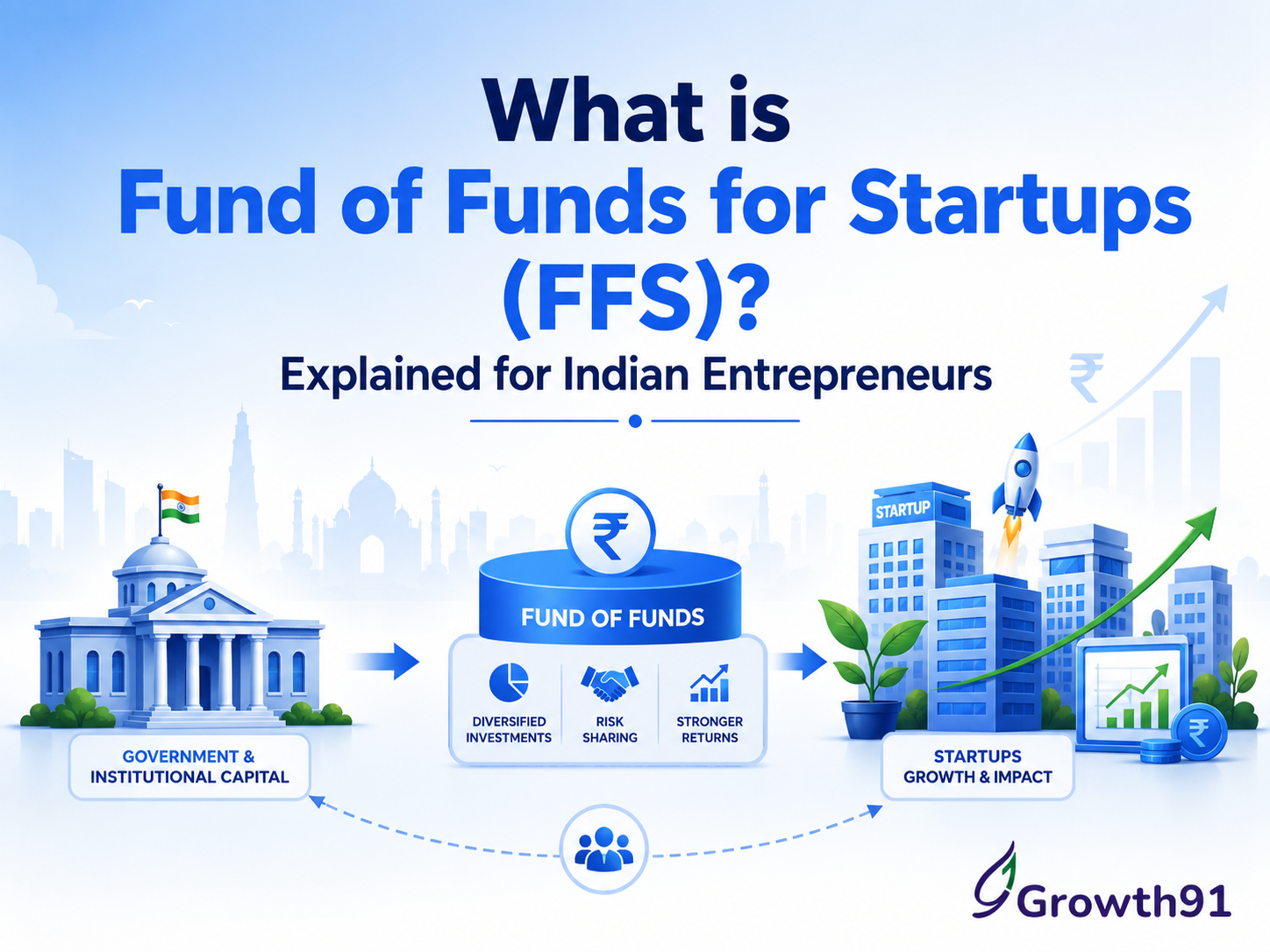
Think of it as a layer in the funding stack:
- Government or institutional capital → goes into the Fund of Funds
- FFS → backs registered VC/AIF managers
- Those managers → invest in early-stage and growth-stage startups
So when people talk about the fund of funds scheme in India, they’re usually referring to a government-backed program designed to increase the flow of private capital into startups — without the government picking individual companies itself.
Fund of Funds for Startups (FFS): The Indian Context
India’s Fund of Funds for Startups (FFS) was set up under the Startup India initiative. It is managed by SIDBI (Small Industries Development Bank of India) and operates as a catalyst fund.
The core idea is simple: India has strong founder talent, but early-stage capital has historically been thin outside a few metro hubs. FFS was created to:
- Mobilize more domestic VC money
- Support fund managers who back startups
- Strengthen the overall startup funding pipeline
- Reduce the funding gap for seed and early-stage companies
FFS doesn’t write cheques to your startup bank account. It strengthens the investors who might.
How Does the FFS Scheme Actually Work?
Here’s a simplified flow:
- Capital allocation — The government allocates corpus to SIDBI for FFS.
- Fund manager selection — SIDBI backs SEBI-registered AIFs and VC funds that meet scheme guidelines.
- Startup investments — Those funds make equity or equity-linked investments in eligible startups.
- Returns cycle — When portfolio startups grow or exit, returns flow back through the fund structure.
For founders, the practical impact is indirect but real. More active VC funds often means more term sheets, faster decisions, and better coverage beyond Tier-1 cities.
If you’re still mapping how rounds and investors fit together, our guide on how startup funding works is a useful starting point.
Who Benefits from FFS?
Startups
You don’t apply to FFS directly. You benefit when an FFS-backed fund invests in you — usually at seed, early, or growth stage depending on the fund’s mandate.
Venture Capital and AIF Managers
FFS gives fund managers more firepower to raise and deploy capital. That helps smaller or newer fund managers who might otherwise struggle to raise a first close.
The Broader Ecosystem
More funds mean more mentorship, more follow-on capital, and more competition among investors — which can improve terms and speed for strong founders.
The Indian VC landscape has shifted a lot in recent years. For a wider view, see navigating the Indian venture capital landscape.
FFS vs Direct Government Grants
Founders sometimes confuse FFS with grants or subsidized loans. They’re different:
| Aspect | Fund of Funds (FFS) | Direct Grants / Schemes |
| Who gets money | VC/AIF funds | Often startups or institutions directly |
| Investment type | Equity route via funds | Grants, subsidies, or debt |
| Founder interaction | Through private fund managers | Through scheme portals and departments |
| Return expectation | Market-driven returns | Policy-driven outcomes |
FFS is market-linked. Funds still do diligence, negotiate valuations, and expect returns. Your pitch, team, and traction matter.
How FFS Fits Into India’s Startup Funding Stack
Indian startup funding today is a mix of:
- Angel investors and angel networks
- Venture capital and growth equity funds
- Corporate venture arms
- Government initiatives like Startup India, SIDBI programs, and FFS
- Platforms that help founders raise funding and connect with investors
FFS sits in the “capital formation” layer — it helps create more VC funds, which then fuel the ecosystem.
Understanding stages of venture capital funding for Indian startups helps you see where FFS-backed funds typically enter — often before large growth rounds, when capital is hardest to find.
What Founders Should Know Before Chasing FFS-Backed Investors
1. You pitch the fund, not the scheme
FFS-backed VCs operate like any other investor. You need a clear problem, traction or a credible roadmap, a strong team, and clean compliance.
2. Sector and stage matter
Each fund has a thesis — SaaS, fintech, deeptech, consumer, climate, and so on. Match your outreach to funds whose portfolio looks like your future.
3. Dilution and terms are still negotiated
Government linkage doesn’t mean soft terms. Cap tables, liquidation preferences, and board rights are still negotiated deal by deal.
4. Policy can evolve
Budget announcements, SIDBI updates, and Startup India changes can affect how aggressively FFS capital is deployed. How economic policies impact startup funding in India is worth reading if you’re planning a raise around policy cycles.
FFS and the Startup India Vision
FFS aligns with broader Startup India goals: more startups, more jobs, more innovation, and a self-sustaining investment ecosystem.
The objectives of Startup India — simplified compliance, funding access, and industry partnerships — work better when private capital is plentiful. FFS was designed as a force multiplier for exactly that.
Is FFS Enough on Its Own?
No single scheme solves every funding gap.
Early founders still lean on:
- Friends and family
- Angel rounds
- Accelerators
- Revenue and bootstrapping
FFS expands the VC layer; it doesn’t replace angels or founder hustle. If you’re at idea or pre-seed stage, angel financing explained may be more immediately relevant than hunting for “FFS” on a pitch deck.
Tips to Attract Investors (Including FFS-Backed Funds)
Want to improve your odds with any serious investor?
- Sharpen your narrative — What problem, for whom, why now?
- Show momentum — Revenue, pilots, LOIs, or product usage beat vague projections.
- Know your numbers — Unit economics, burn, runway.
- Build social proof — Advisors, customers, prior investors.
- Use the right channels — A startup funding platform can help you reach curated investors instead of cold-emailing blindly.
For tactical advice, read top strategies to attract investors to your startup.
If you’re actively raising, explore Growth91’s founders page — built to help startups connect with the right funding opportunities.
Future of Startup Funding and FFS
India’s startup funding market has matured. More domestic LPs, family offices, and institutional players are participating. FFS helped seed that culture by backing homegrown fund managers.
Looking ahead, expect:
- More sector-specific funds (climate, healthtech, SaaS, manufacturing)
- Deeper capital in Tier-2 and Tier-3 hubs
- Closer links between policy, banking, and private VC
For a forward-looking view, see the future of startup funding: trends and predictions in India.
Should You Care About FFS as a Founder?
Yes — but indirectly.
You probably won’t fill out an “FFS application.” You should know which funds in your space are active, well-capitalized, and aligned with your stage. Some of those funds may have benefited from the fund of funds for startups FFS program.
That knowledge helps you target the right investors, time your raise, and understand why India’s VC scene has more depth than it did a decade ago.
For investors watching this space, platforms that help you invest in Indian startups with proper diligence are becoming essential. Growth91 is one such startup investing destination — connecting investors and founders with transparency and access.
Conclusion
The Fund of Funds for Startups (FFS) is a government-backed fund of funds scheme that channels capital into VC and AIF managers, who then invest in startups. It doesn’t fund founders directly, but it strengthens the entire startup funding engine in India.
For entrepreneurs, the takeaway is practical: learn the scheme, focus on fund-fit, and build a company worth backing. FFS made more investors possible — your job is to become a company those investors can’t ignore.
FAQ
What is Fund of Funds for Startups (FFS)?
FFS is a SIDBI-managed initiative under Startup India that invests in registered VC/AIF funds, which then invest in startups.
Can startups apply directly to FFS?
No. Startups raise from VC funds and AIFs. FFS supports those funds, not individual companies.
What is the difference between FFS and a normal VC fund?
A VC fund invests directly in startups. FFS invests in VC/AIF funds — it’s a fund of funds.
Is FFS only for early-stage startups?
FFS-backed funds may invest across stages depending on their mandate — seed, early, and growth.
How does FFS help Indian entrepreneurs?
It increases the number and size of VC funds operating in India, improving access to funding for startups nationwide.
Does FFS guarantee funding for my startup?
No. You still need a strong team, product, and pitch to win investment from FFS-backed funds.
Leave a Reply