

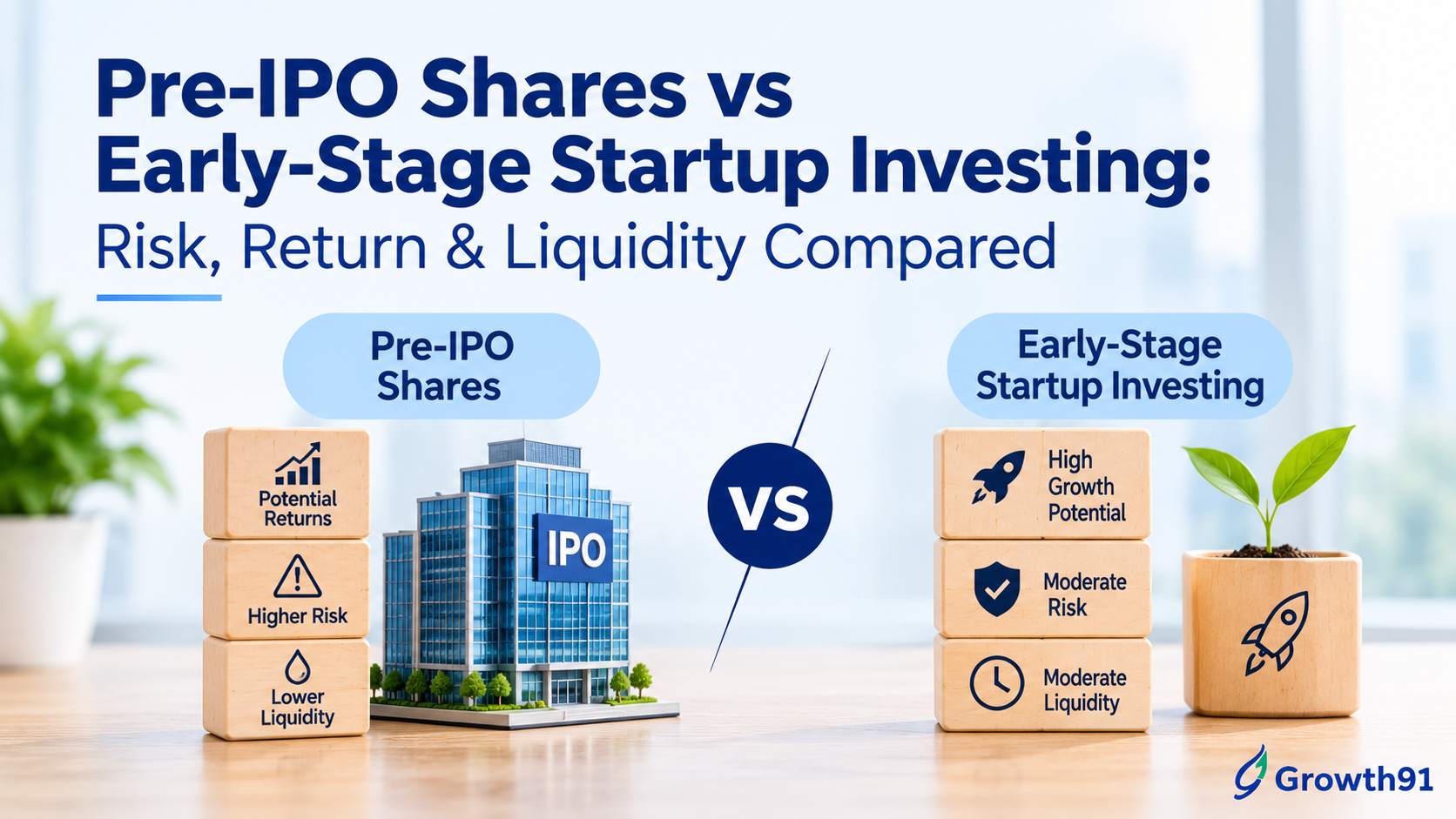
Pre-IPO shares and early-stage startup investments are both shares of unlisted Indian companies, but they behave very differently.
- Pre-IPO shares are in mature companies expected to list in the next few years. They carry lower risk of total loss, a shorter wait and more modest upside.
- Early-stage startup investing backs young companies years before any exit. It carries a high chance of loss and a long wait, and a few winners can return many times your money.
When you compare pre-IPO shares vs startup investing, the right choice depends on your timeline, your tolerance for loss and how much you want to research each company.
Key takeaways
- Pre-IPO shares are bought in established private companies close to listing. Early-stage investments go into startups at the seed or pre-seed stage.
- Early-stage startups fail far more often, but the best ones can return many times your money. Pre-IPO returns are usually more modest and depend on the listing price.
- After an IPO, pre-IPO shares held by non-promoters are generally locked in for six months from IPO allotment.
- Gains on pre-IPO shares sold on the exchange after listing are taxed as listed equity. The holding period is generally counted from your original purchase.
- Many investors hold both: early-stage deals for long-term upside, and pre-IPO shares for a shorter route to liquidity.
What is the difference between pre-IPO shares and early-stage startup investing?
Pre-IPO shares are shares of an unlisted company that is expected to list on a stock exchange within a foreseeable period, usually a few years. These companies are typically established, with years of revenue and several funding rounds behind them. You usually buy existing shares from employees or early investors through an off-market transfer into your demat account. Occasionally you can buy in a private placement shortly before the IPO.
Early-stage startup investing means buying newly issued shares in a young company’s seed or pre-seed round, often before it has meaningful revenue. The company uses your money to grow, and your return depends on an exit years later.
Both are unlisted, illiquid and higher-risk than listed equity. The key difference is where on its path the company sits when you invest: near the end, with more certainty and less upside, or near the start, with less certainty and more upside.
Pre-IPO shares vs startup investing: side-by-side comparison
| Factor | Pre-IPO shares | Early-stage startup investing |
| Company stage | Established, often several funding rounds in, preparing to list | Idea, pre-seed or seed stage, often pre-revenue or early revenue |
| How you buy | Existing shares from employees or early investors, off-market | New shares issued by the company in a private placement round |
| Who sets the price | Dealers and sellers in the unlisted market | Negotiated valuation at each funding round |
| Typical minimum | Varies by lot size and price | Commonly a few lakh rupees per deal (₹2 lakh on Growth91) |
| Risk of total loss | Lower, but not zero | High for each individual company |
| Return potential | Usually modest multiples, depends on listing price | Many times your money for a few winners, zero for many |
| Typical holding period | Often one to three years, including any post-listing lock-in | 5 to 7 years or more |
| Liquidity before exit | Some, through the unlisted market, often at a discount | Very little until an acquisition, IPO or buyback |
| Lock-in after IPO | Generally six months from IPO allotment for non-promoters | Same rule applies if the startup eventually lists |
| Information available | Annual reports and, closer to listing, a public draft prospectus | Pitch deck, financials and access to founders |
| Main risks | Overpaying, IPO delay or cancellation, listing below your price | Failure, dilution, long wait |
How do risk and return compare?
The two carry different kinds of risk:
- Early-stage investing: The main risk is that the company fails. A large share of startups never reach a meaningful exit, and your investment in those becomes worthless.
- Pre-IPO shares: The main risk is overpaying. The company is usually established and unlikely to vanish, but the price you pay in the unlisted market can be well above where the shares eventually trade after listing.
Returns follow the same pattern. Early-stage portfolios follow a power law, where one or two big winners make up for many failures. A strong outcome can return dozens of times your money on a single company. Pre-IPO returns are narrower. You gain if the company lists, and trades six months later, above your purchase price. You lose if it lists lower, delays its IPO or doesn’t list at all. Pre-IPO shares are more predictable, but rarely life-changing.
Worked example: ₹2 lakh in each
These are illustrations, not forecasts.
Pre-IPO shares. You buy 400 shares of a company preparing to list, at ₹500 each in the unlisted market, for a total of ₹2 lakh. Here’s what your ₹2 lakh could be worth when the six-month lock-in ends after listing:
| Scenario | Price when lock-in ends | Value of your 400 shares | Result |
| Lists below your price, stays weak | ₹350 | ₹1.4 lakh | Lose 30% |
| Lists near your price | ₹520 | ₹2.08 lakh | Gain 4% |
| Lists strongly and holds | ₹800 | ₹3.2 lakh | 1.6x |
Early-stage startup. You invest ₹2 lakh in a seed round at a ₹10 crore post-money valuation and own 0.2%. Over 7 years or more, the outcomes are:
- Shuts down (a common outcome): your ₹2 lakh becomes zero.
- Modest acquisition: you get roughly your money back.
- Becomes a large company: your diluted stake could be worth many times your ₹2 lakh. For example, at 0.13% after later rounds, a ₹500 crore exit is worth about ₹65 lakh before tax.
The pre-IPO range is narrow, while the early-stage range runs from zero to very large. That’s why early-stage investing needs 10 or more companies, while a pre-IPO position can make sense in smaller numbers, as long as you buy at a sensible price.
How do liquidity and lock-in compare?
Before listing: Neither investment is easy to sell. Pre-IPO shares can sometimes be resold in the unlisted market, but buyers aren’t guaranteed and prices are set by dealers, often with a wide gap between buying and selling prices. Early-stage shares usually can’t be sold at all until an acquisition, a later funding round with a secondary sale, a buyback or an IPO.
After listing: Both face the same lock-in rule. Under Regulation 17 of the SEBI ICDR Regulations 2018, shares held before the IPO by people other than promoters are locked in for six months from the IPO allotment date. Shares allotted to employees before the IPO under a compliant ESOP scheme are exempt.
That lock-in matters more than most investors expect. You live through six months of post-listing price swings without being able to sell, so judge your pre-IPO purchase price against where the stock might trade six months after listing, not against a strong first day.
How are pre-IPO shares and startup investments taxed?
Tax depends on whether you sell before or after the company lists:
- Sold while still unlisted (early-stage shares, or pre-IPO shares sold before the IPO): Long-term gains on unlisted shares held for more than 24 months are taxed at 12.5% without indexation, under Section 197 of the Income-tax Act 2025 (Section 112 of the 1961 Act). Earlier sales are taxed at your slab rate.
- Sold on the exchange after listing: The shares are taxed as listed equity. Gains on shares held for more than 12 months are taxed at 12.5% above ₹1.25 lakh a year under Section 198 (formerly Section 112A), and shorter holdings at 20%. The holding period generally runs from the date you bought the unlisted shares, including the time before listing.
Surcharge and cess apply on top in both cases. Tax practitioners have differed on how the holding period is counted for shares bought before listing, so confirm your position with a chartered accountant before you file.
Worked example: pre-IPO tax timing
Say you buy pre-IPO shares in January 2027. The company lists in July 2027, the six-month lock-in ends in January 2028, and you sell on the exchange in February 2028.
- Holding period from purchase: 13 months, which is more than 12 months
- Treatment: long-term capital gain on listed equity, taxed at 12.5% on the part of your total listed equity gains for the year above ₹1.25 lakh.
If instead the IPO is delayed and you sell to another buyer in the unlisted market after 20 months, the gain is short-term, because the 24-month test for unlisted shares applies. It’s added to your income and taxed at your slab rate.
Which suits you: pre-IPO shares or early-stage startups?
Pre-IPO shares suit investors who want exposure to private companies with a shorter, more visible path to liquidity. Early-stage investing suits investors who can wait 5 to 7 years or more, can afford to lose individual investments and want the chance of large returns.
Pre-IPO shares may suit you if:
- you want a holding period of one to three years rather than seven or more
- you prefer established companies with audited financials and a track record
- you’re comfortable researching valuations against listed peers
- you accept the six-month post-listing lock-in.
Early-stage startups may suit you if:
- you can commit money for 5 to 7 years or more
- you can build a portfolio of 10 or more companies over time
- you enjoy evaluating founders, markets and products
- you understand that many investments will fail.
Many investors hold both. One approach is to keep most of your startup allocation in early-stage deals for long-term upside, and a smaller share in pre-IPO shares for nearer-term liquidity. The whole startup slice should still stay within a small share of your investable assets, often 5% to 10%. If you’re starting with a limited budget, our guide on how to invest in startups with a small amount shows how to build either position ₹2 lakh at a time.
What should you check before buying pre-IPO shares?
Pre-IPO shares carry risks of their own, and most come down to price, paperwork and the seller. Before you buy, check:
- Valuation against listed peers: Compare the implied company valuation with similar listed companies. A strong business bought at too high a price can still lose money.
- IPO status: Has the company filed a draft red herring prospectus (DRHP) with SEBI? A filed DRHP gives detailed disclosures and a clearer timeline. Without one, “pre-IPO” may be years away or may never happen.
- Latest financials: Read the latest annual reports, which are available through the Ministry of Corporate Affairs, rather than relying only on a dealer’s summary.
- Delivery before payment, or at the same time: Make sure the shares will be transferred to your demat account through a proper off-market transfer, and understand the settlement process before you pay.
- Transfer restrictions: Some companies restrict share transfers in their articles of association or shareholder agreements.
- The platform or dealer: In June 2026, SEBI warned investors against dealing in unlisted securities of public companies through electronic platforms it hasn’t authorised, noting that investors on such platforms have no access to grievance redressal.
Our beginner’s guide to unlisted shares explains the buying process and paperwork in more detail.
What should you check before an early-stage investment?
Early-stage investing turns on judgement more than price. Check:
- The founders: their experience, how they work together and their commitment to the business
- The traction: real customers using or paying for the product
- The market: large enough to support a big outcome
- The runway: at least 12 to 18 months after the round
- The terms: the instrument, valuation, liquidation preference and your information rights.
Platforms can help with screening. Growth91, for example, lists startups only after a vetting process and invests alongside its investors in each deal it features. You still make the final call. For the full process from choosing a route to receiving your shares, see our guide on how to invest in startups in India.
Frequently asked questions
Are pre-IPO shares safer than early-stage startups?
Generally, yes, in terms of the company surviving. Pre-IPO companies are usually established, with revenue and several funding rounds behind them. The bigger risk with pre-IPO shares is overpaying in the unlisted market, or the IPO being delayed or listing below your price. Early-stage startups carry a much higher risk of failure, offset by higher potential returns.
What is the lock-in period for pre-IPO shares in India?
Under Regulation 17 of the SEBI ICDR Regulations 2018, shares held before an IPO by people other than promoters are generally locked in for six months from the date of IPO allotment. Shares allotted to employees under a compliant ESOP scheme are exempt. Promoters face longer lock-ins on part of their holding.
How are pre-IPO shares taxed after listing?
If you sell on the stock exchange after listing, the shares are taxed as listed equity. Gains on holdings of more than 12 months are taxed at 12.5% above ₹1.25 lakh a year, and shorter holdings at 20%, plus surcharge and cess. The holding period is generally counted from your original purchase. Confirm the details with a chartered accountant.
Can pre-IPO shares lose money?
Yes. Pre-IPO shares can list below the price you paid in the unlisted market, and the six-month lock-in means you can’t sell during early post-listing weakness. IPOs can also be delayed or cancelled, leaving you holding unlisted shares with limited buyers. Always compare the price you’re paying with valuations of similar listed companies.
Should a beginner start with pre-IPO shares or early-stage startups?
It depends on your timeline. If you want a shorter holding period and prefer established companies, pre-IPO shares may feel more familiar. If you can wait 5 to 7 years or more and build a portfolio of 10 or more companies, early-stage investing offers higher potential returns. Either way, keep both within a small share of your investable assets.
Conclusion
Comparing pre-IPO shares vs startup investing comes down to timing:
- Pre-IPO shares put you in established companies close to listing, with a shorter wait, a six-month post-listing lock-in and more modest, price-sensitive returns.
- Early-stage investing puts you in young companies years before any exit, with a high chance of individual losses and the possibility of very large wins.
Many investors combine both within a small allocation. Whichever you choose, check the price, the paperwork and the company before you invest in startups. Growth91 offers both early-stage deals and a section for buying and selling unlisted startup shares. To review current early-stage opportunities, you can see live startup deals on Growth91.
Risk note: Startup and unlisted share investments are high risk and illiquid. They can result in the total loss of your capital, and you may not be able to sell your shares for many years. This article is for educational purposes only and is not investment, tax or legal advice.
Leave a Reply