

Introduction
Every year, thousands of Indian founders pitch to angel investors hoping to raise their first meaningful round of capital. Most walk away without a term sheet—not because their idea was bad, but because they didn’t understand what angels actually look for before writing a check.
Angel investors are not just ATMs with business cards. They are experienced individuals—operators, entrepreneurs, executives, and family office principals—who deploy personal capital into early-stage startups in exchange for equity. They take enormous risk on companies with more potential than proof. In return, they expect founders who understand their business deeply, have evidence of early traction, and can articulate a credible path to scale.
This pillar guide answers the most important question every early-stage founder needs to understand: what do angel investors look for before funding you? It covers who angels are, how they think, what the top angel investors in India evaluate across every dimension, how the angel network ecosystem is structured, and how founders can improve their chances of securing angel funding in India.
Whether you are raising your first round or advising a founder who is, this is the complete reference.
What Is an Angel Investor? A Precise Definition
An angel investor is a high-net-worth individual who invests personal capital—typically ₹10 lakh to ₹5 crore per check in India—into early-stage startups in exchange for equity, a convertible note, or an iSAFE instrument. Unlike venture capitalists who manage pooled institutional funds, angels invest their own money, make faster decisions, and typically get involved at stages too early for institutional capital.
The term “angel” reflects their role: they appear at the most uncertain stage of a company’s life, when no institutional fund will touch it, and provide both capital and confidence.
In India’s startup ecosystem, angel investors occupy a specific and critical position:
- They fund the pre-seed and seed stages before VCs become relevant
- They often provide mentorship, network access, and industry credibility alongside capital
- They typically hold equity for 5–10 years before any liquidity event
- They accept that most of their investments will fail—and factor this into their portfolio strategy
For a deeper understanding of the full mechanics of how this works—including instruments like iSAFE, typical check sizes, and the fundraising process step by step—our post Angel Financing Explained: The Smartest Way to Fund Your Startup Early is the natural companion to this guide.
The Angel Investing Landscape in India: 2025–2026
India’s angel investing ecosystem crossed the $1 billion mark in 2025, establishing it as the third-largest startup ecosystem globally by angel participation. However, 2025 was also a year of significant reset: angel investment deal volume fell 44% to 834 deals from 1,495 deals in 2024, driven by tighter SEBI accreditation norms and new compliance requirements that raised entry thresholds for smaller participants.
What this means for founders: the angels who remain active are more selective, more disciplined, and more focused on quality over quantity. Understanding their evaluation framework has never been more important.
Key 2025–2026 data points founders should know:
- Seed-stage investment reached $188 million in Q1 2025 alone, up 18% year-on-year
- Kunal Shah (CRED) leads active Indian angels with 287+ investments; Anupam Mittal has backed 245+ startups
- IPV (Inflection Point Ventures) remained India’s most active angel platform in 2025 with 46 investments
- Fintech, SaaS, and climate tech attract the highest angel participation by deal volume
- NRI and diaspora capital flows are accelerating following the abolition of angel tax in April 2025
The 7 Core Things Angel Investors Evaluate Before Funding
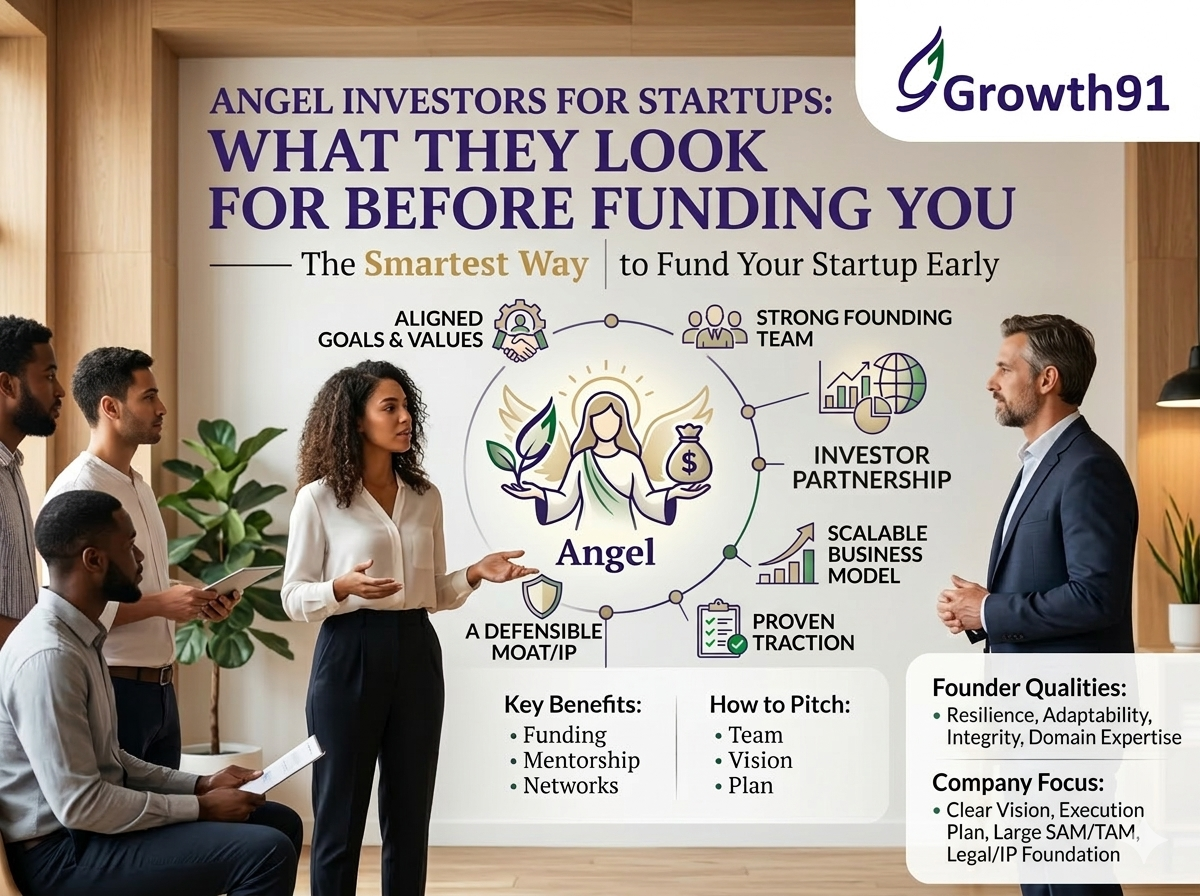
This is the heart of what every founder needs to understand. Research across angel networks, investor interviews, and deal data consistently shows that angel investors in India evaluate startups across seven core dimensions—often simultaneously, within a 20–30 minute first conversation.
1. The Founding Team: The Most Important Factor
Multiple analyses of angel investment decisions confirm that founder quality accounts for 30–40% of an angel’s investment decision—more than any other single factor. This is especially true at pre-revenue stages where there is little else to evaluate.
What angels assess in the founding team:
- Domain expertise: Does the founder understand the problem from lived experience or professional depth? “Insider founders” who have worked in the industry they are disrupting have significantly higher success rates.
- Coachability: Paradoxically, founders who are confident enough to have a clear vision but humble enough to incorporate investor feedback are the most fundable. Arrogance is one of the fastest ways to lose an angel’s interest.
- Resilience and commitment: Has the founder left a well-paying job to pursue this? Have they been working on this for months before raising? Skin in the game matters enormously.
- Complementary co-founders: Solo founders face significantly higher scrutiny. A founding team with complementary skills—technical + commercial, for example—de-risks execution.
- Integrity and transparency: Angels do reference checks. How a founder handles bad news, early failures, or uncomfortable questions tells investors everything about long-term trustworthiness.
For a detailed framework on how investors evaluate founder quality specifically, our existing article on Evaluating Startup Founders: Unveiling the Pillars of Success goes deep on every dimension angels probe.
2. Market Size: Large Enough to Matter
Even the best founder in a tiny market produces limited returns. Angel investors in India look for startups addressing Total Addressable Markets (TAM) of at least ₹500 crore–₹1,000 crore in India, with ideally a global opportunity or pan-India scalability.
But here’s what most founders misunderstand: angels don’t just want a large TAM slide. They want to see that the founder understands:
- Serviceable Addressable Market (SAM): The portion of TAM the startup can realistically serve given its current model, geography, and resources
- Serviceable Obtainable Market (SOM): The specific customers the startup can win in the next 12–18 months
- Market timing: Is the market ready now? Why is this the right moment for this solution?
Bottom-up market sizing—built from customer data rather than top-down “we’ll capture 1% of a $10 billion market”—earns significantly more credibility.
3. Problem-Solution Clarity: The Customer’s Pain, Not the Founder’s Pride
Angels fund solutions to real problems. The most common early-stage mistake founders make is describing their product’s features when they should be describing their customer’s pain.
A compelling problem statement answers three questions:
- Who specifically suffers from this problem? (Not “SMEs”—but “a 15-person manufacturing company in Pune spending 8 hours a week reconciling GST invoices manually”)
- How painful is it? (Are people already spending money on workarounds, indicating they’ll pay for a better solution?)
- Why hasn’t it been solved before? (What has changed—in technology, regulation, or consumer behavior—that makes now the right moment?)
Angels who hear founders say “we are building a platform for everyone” immediately disengage. The ability to describe one customer’s pain with precision is a proxy for the discipline that will drive effective product development, sales, and hiring.
4. Business Model: How Will You Make Money?
Angel funding India is increasingly directed toward startups with clear, believable paths to revenue—not just growth. Angels ask three business model questions:
- What is the revenue mechanism? (Subscription, transaction fee, marketplace take rate, hardware + software, etc.)
- What are the unit economics? (CAC, LTV, gross margin, payback period—even at early stages, founders should have hypotheses with evidence)
- When do you become profitable? (Not a specific date, but a clear understanding of what revenue or operational milestone enables profitability)
Startups that cannot articulate basic unit economics—even at the idea stage—suggest to angels that the founders have not done the disciplined thinking required to build a sustainable business.
For founders who want to understand how unit economics and business model clarity affect startup valuations specifically, our guide on Startup Valuation Methods: What Investors Really Look At provides a clear framework.
5. Traction: Proof That Someone Wants This
Traction is the most powerful signal an angel can receive. It doesn’t have to be large—but it has to be real.
Traction hierarchy (from most to least compelling):
- Paying revenue: Even ₹1 lakh/month in revenue with strong retention is more compelling than 10,000 free users
- Waitlists with intent signals: Users who’ve shared contact details, referral codes activated, or pilots signed
- Letters of Intent: Potential customers who have formally committed to piloting or purchasing
- Strong retention/engagement: Users who return repeatedly, indicating genuine problem-solution fit
- Customer interviews that reveal willingness to pay: Qualitative evidence that customers recognize the problem and would pay to solve it
What angels are really asking when they look at traction: Has this founder gotten out of the building and tested their assumptions against reality? Founders who have real customer conversations—and have updated their product or model based on feedback—signal execution capability.
6. Competitive Landscape and Defensibility
“We have no competition” is one of the most alarming things a founder can say to an angel. It either means the founder hasn’t researched the market, or there genuinely is no market.
What angels look for instead:
- Honest competitive mapping: Who solves this problem today, even imperfectly? Why is the current solution inadequate?
- Sustainable differentiation: Is the advantage a temporary feature lead (easily copied) or a structural moat (network effects, proprietary data, regulatory licenses, brand loyalty, or switching costs)?
- Go-to-market advantage: Does the founding team have an unfair distribution advantage—industry relationships, a proprietary channel, or domain credibility—that competitors can’t easily replicate?
7. Exit Pathway: How Will Investors Get Their Money Back?
Angels invest for returns. Without a realistic exit pathway—acquisition, strategic buyout, or IPO—there is no return. This is one of the most underrated elements of a pitch.
Founders should be able to articulate:
- Who are the likely acquirers in this space? (Strategic corporates, larger players, international companies expanding into India)
- What valuations have comparable exits fetched? (5x revenue? 10x EBITDA?)
- What milestones make this company acquisition-ready?
For a comprehensive look at how exit strategies are structured and what angels and investors look for in exit planning, Understanding Exit Strategies in Startup Investments provides the investor perspective in full detail.
Top Angel Investors in India: Who Is Actually Writing Checks
Here is a curated list of angel investors in India who are active in 2025–2026, based on verified deal data and public investment records:
Most Active Individual Angels:
| Angel Investor | Background | Focus Sectors | Investments |
| Kunal Shah | CRED, FreeCharge | Fintech, consumer, health | 287+ |
| Anupam Mittal | Shaadi.com | Consumer, fintech, D2C | 245+ |
| Rajan Anandan | Google India | SaaS, deep tech, consumer | 123+ |
| Ramakant Sharma | Livspace | Consumer, proptech | 119+ |
| Binny Bansal | Flipkart | E-commerce, logistics, B2B | 75+ |
| Vijay Shekhar Sharma | Paytm | Fintech, consumer | 76+ |
| Ronnie Screwvala | UTV, upGrad | Edtech, media, consumer | 50+ |
| Ratan Tata (legacy) | Tata Sons | Consumer, healthtech, social | 40+ |
For a city-specific breakdown of Mumbai’s angel landscape—including named investors, their individual investment thesis, and outreach strategies that work—our cluster post Top Angel Investors in Mumbai and How to Get Their Attention gives you everything you need for that specific geography.
How the Angel Network Ecosystem Works in India
An angel network is a structured organization that pools individual angel investors together to co-invest in startups, enabling:
- Larger collective round sizes (₹1–5 crore+ from a single syndicated round)
- Faster due diligence through shared resources and sectoral expertise
- Lower individual ticket sizes (each member can invest ₹10–25 lakh while the total round is much larger)
- Credibility signaling for startups (being backed by a recognized network validates the business)
How angel networks evaluate startups:
Most organized networks run a structured 3–5 stage process:
- Initial application / screening: Founders submit a deck and one-pager. Screeners check for basic investment criteria fit.
- Internal review: A small committee evaluates the business model, founder background, and market opportunity.
- Due diligence: Deep dive on financials, legal compliance, customer references, and competitive landscape.
- Pitch presentation: Founders present to the full investor group—sometimes 20–100 individuals simultaneously.
- Term negotiation and closing: Interested investors indicate commitment; legal documentation is prepared and signed.
The entire process typically takes 6–14 weeks for a first meeting to close, though platforms like 100X.VC that use standardized iSAFE instruments can compress this to 4–6 weeks.
Angel Investing Platforms vs. Individual Angels: What Founders Should Know
Angel investing platforms and angel investing companies have fundamentally changed how founders access early-stage capital in India. Instead of cold-emailing individual investors and spending 6 months building relationships, founders can apply to structured platforms and access dozens of investors simultaneously.
Key differences:
| Factor | Individual Angel | Angel Network | Angel Investing Platform |
| Decision Speed | 1–4 weeks | 6–14 weeks | 4–10 weeks |
| Round Size | ₹10L–₹2Cr | ₹1–5Cr | ₹50L–₹10Cr+ |
| Value Add | High (if right fit) | Moderate-High | Moderate |
| Access | Relationship-dependent | Application-based | Application-based |
| Compliance | Informal | Structured | Structured |
For founders asking how to find angel investors in India’s current landscape, the practical hierarchy is:
- Warm introductions through portfolio founders of active angels (highest conversion)
- Structured applications to angel networks and platforms (most accessible)
- Accelerator programs that connect cohorts to investor networks (Antler, Axilor, NSRCEL)
- Direct outreach via LinkedIn or X with personalized, research-backed messages (lowest conversion but scalable)
How to Become an Angel Investor in India
For professionals and entrepreneurs asking how to become an angel investor in India, the landscape changed significantly in 2025 with SEBI’s revised accreditation requirements.
Current pathways:
Individual Angel Investing (Unregulated Route)
Any HNI can invest directly into startups as an individual. There are no regulatory entry requirements for direct investments. This is the simplest path for professionals wanting to make 2–5 investments per year from personal capital.
- No minimum regulatory threshold for direct investments
- Standard shareholder agreements and due diligence practices apply
- Angel tax is fully abolished (since April 2025), removing previous tax complications
SEBI-Registered Angel Fund Participation
Investing through a SEBI-registered angel fund (a sub-category of AIF Category I) now requires accredited investor status following the September 2025 reforms. This means:
- Meeting income/net worth thresholds (typically ₹2Cr+ net worth or ₹50L+ annual income)
- Accepting lock-in periods (6 months for third-party exits, 1 year for buybacks)
Recommended approach for first-time angel investors:
Start with individual direct investments through platforms like Growth91, where deal sourcing, due diligence, and monitoring are handled professionally. This builds investment experience without requiring immediate compliance with SEBI AIF frameworks.
For first-time investors specifically, our detailed guide on How First-Time Investors Can Start Investing in Indian Startups with Minimal Risk walks through the complete process with actionable guidance.
What Founders Must Prepare Before Approaching Angels
Understanding what angels look for is only half the battle. The other half is preparation. Here is what every founder needs to have ready before the first investor conversation:
1. A Tight Pitch Deck (10–12 slides)
Problem → Solution → Market → Business Model → Traction → Team → Financials → Ask. Nothing more, nothing less. Your deck’s job is to earn a meeting—not to close a round.
2. Basic Financial Model
Revenue assumptions, cost structure, burn rate, path to milestone. Even rough projections with clearly stated assumptions signal business maturity.
3. Legal and Compliance Hygiene
- Company incorporated with MCA (Private Limited recommended for fundable startups)
- DPIIT recognition applied for or secured
- Clean cap table with no undocumented equity promises
- Basic shareholder agreements in place
Non-compliance is one of the most common late-stage deal killers. Our article on Startup Compliance India: From Maze to Smooth Operations covers every compliance item investors check during due diligence.
4. Customer Evidence
Even 10 customer conversations with documented insights are more compelling than a theoretical market analysis. If you have paying customers, retention data, or letters of intent—lead with this.
5. Clear Funding Ask
Amount needed, use of funds, milestones the capital will achieve, and timeline. Vague asks signal undisciplined thinking.
The Regulatory Environment for Angel Investing in 2026
The environment for angel funding India has never been more transparent—though also more structured:
Angel Tax: Fully Abolished (April 2025)
Section 56(2)(viib) was repealed, eliminating tax on investments above Fair Market Value. Founders can raise at market-determined valuations without unexpected tax liabilities. Full details in our explainer on Angel Tax Abolished: What This Means for Early-Stage Startup Investments in India.
SEBI Accreditation Requirements (September 2025)
New accreditation norms for angel fund participation raised entry thresholds, contributing to a 44% decline in deal volumes in H2 2025. However, most experts view this as a healthy rationalization that removes ultra-small, uninformed capital while retaining serious investors.
DPIIT Tax Holiday (Extended to April 2030)
Startups with DPIIT recognition retain 100% tax exemption on profits for three consecutive years—a significant financial benefit that improves post-investment returns for angels. For the complete picture on how budget measures support early-stage investing, see Startup Tax Benefits 2026 Budget: What Changed for Investors
.
Growth91: Where Angel Investing Meets Rigorous Vetting
For investors asking how to find angel investors websites or platforms worth trusting, and for founders looking for the most efficient path to India’s angel community, Growth91 offers something distinct from most angel investing companies in the market.
Growth91 is not a passive listing platform. Every startup featured on the platform undergoes structured multi-layer due diligence—covering team credentials, legal compliance, business model viability, market validation, and financial projections. Critically, Growth91 invests its own capital alongside every investor—a “skin in the game” commitment that fundamentally aligns incentives.
For founders, listing on Growth91 Founders
provides:
- Access to a pre-qualified community of angels and family offices actively deploying capital
- Professional due diligence support that prepares you for investor scrutiny
- Growth91’s own co-investment as a credibility signal to other investors
- Post-investment monitoring and support across your funding journey
For investors, Growth91 provides:
- Curated deal flow screened for the criteria covered in this guide
- Transparent information on each startup’s compliance, financials, and traction
- Portfolio diversification across sectors and stages without requiring individual relationship-building
- Co-investment from Growth91’s own team, ensuring aligned interests
Conclusion: What the Best-Funded Founders Do Differently
India’s most successfully funded early-stage founders share a common pattern: they understand the angel’s perspective before they pitch. They know that angels are investing personal capital into high-risk bets. They know that rejection is statistical, not personal. And they prepare with the discipline of someone who respects both the investor’s time and the complexity of building a fundable company.
The seven things angels look for—founder quality, market size, problem clarity, business model, traction, defensibility, and exit pathway—are not arbitrary hurdles. They are the dimensions that consistently predict whether a startup survives, scales, and creates returns.
Master these dimensions. Prepare with evidence. Approach with personalization. And partner with the right investors who bring more than capital—the mentors, connectors, and advocates who accelerate the journey from idea to impact.
To continue building your complete angel investing knowledge base:
- For city-specific investor names, investment thesis, and outreach strategies:
- Top Angel Investors in Mumbai and How to Get Their Attention
- For a complete explanation of how angel financing instruments work, what terms mean, and how to structure a round:
- Angel Financing Explained: The Smartest Way to Fund Your Startup Early
Leave a Reply