

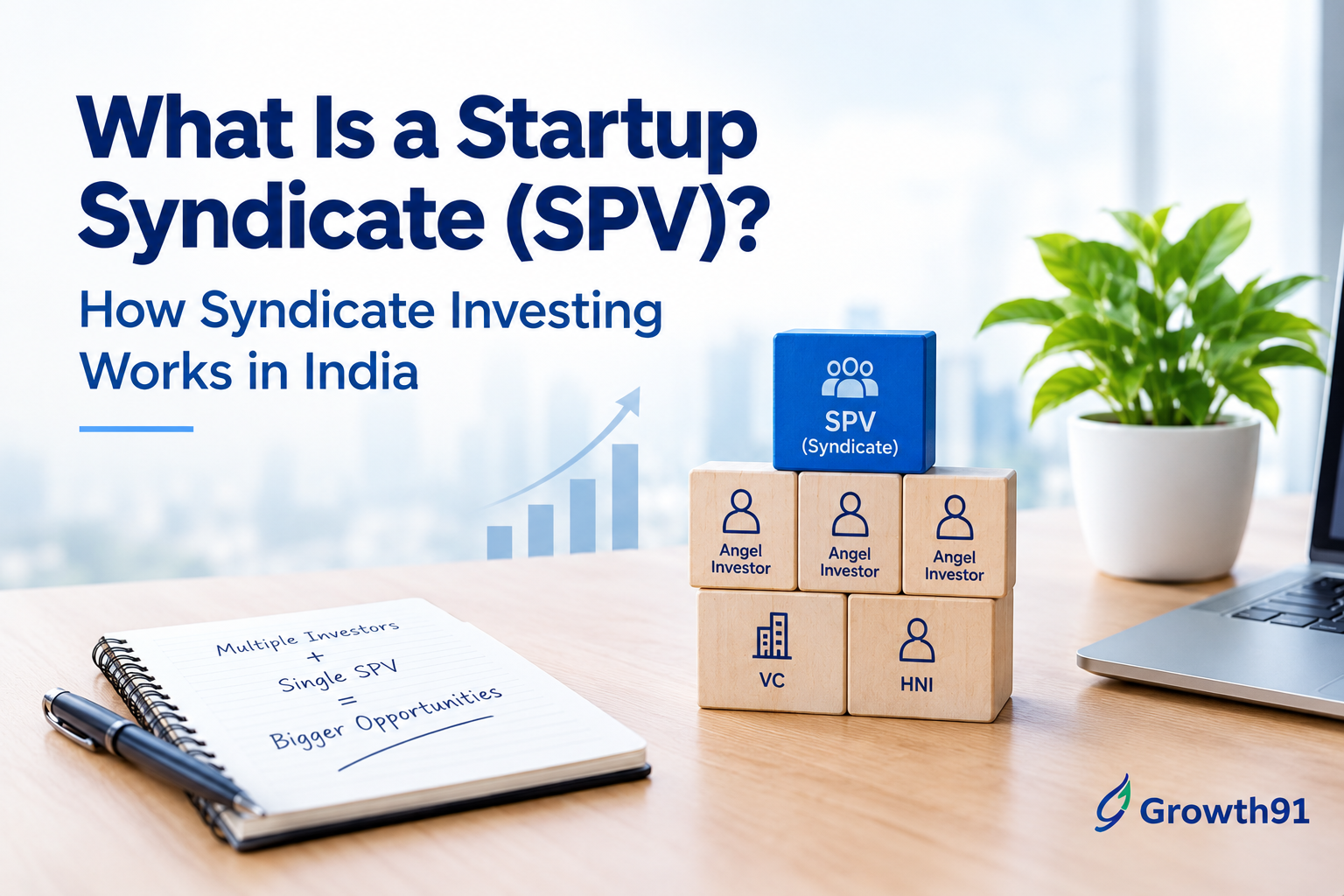
A startup syndicate is a group of investors who back a startup together. One experienced investor leads: they find the deal, negotiate the terms and invite others to join. In the US, syndicates usually pool everyone’s money in an SPV (special purpose vehicle), which then appears on the startup’s cap table as a single investor. In India, pooling money through an unregistered SPV runs into SEBI’s AIF Regulations. So a startup syndicate in India usually works in one of two ways: members invest directly in the startup, or they invest through a SEBI-registered angel fund. The structure decides who can join, what you own and what you pay, and this guide explains each one.
Key takeaways
- A startup syndicate is a group of investors backing a deal together under a lead investor. An SPV is a separate entity that pools their money into one shareholding.
- SEBI’s AIF Regulations govern privately pooled investment vehicles. That’s why Indian syndicates mostly use direct investment or SEBI-registered funds rather than informal SPVs.
- In a direct syndicate, you hold shares in your own name, within the Section 42 limit of 200 persons per type of security each year.
- Syndicates that run through SEBI angel funds now accept only accredited investors. Older angel funds must comply by 31 March 2027.
- The lead investor’s track record, own cheque and fees matter more than any single deal.
What is a startup syndicate?
A startup syndicate is a group of investors who invest in the same startup round together, organised by a lead investor. The lead is usually an experienced angel, operator or founder. They find the startup, check it, negotiate the valuation and terms, and then invite a group of backers to invest alongside them. Each backer decides deal by deal whether to join. In return for their work, the lead usually takes a share of the backers’ profits, called carry. Syndicates sit between investing on your own and investing in a fund. You get deal flow and diligence from someone with more experience, but you keep the final decision on every company. For founders, a syndicate brings many smaller cheques together into one coordinated investment, with a single point of contact instead of dozens of separate negotiations. Many angel networks in India work on a similar model, and the term “syndicate” is often used loosely to describe both.
Most syndicates have four parties:
- The lead investor: sources the deal, writes the investment memo, negotiates terms and usually stays involved after the round
- The backers: investors who review the memo and choose to invest
- The startup: receives the money and issues the shares
- The administrator: a platform, network or fund manager that handles documents, money flows and compliance.
What is an SPV in startup investing?
An SPV (special purpose vehicle) is a separate legal entity created to hold one investment on behalf of a group of investors. Instead of 40 backers each buying shares in the startup, the backers put money into the SPV, and the SPV buys the shares. On the startup’s cap table, the SPV shows up as a single shareholder. Founders like this because it keeps the cap table clean and means they deal with one signatory instead of 40.
The model is common in the US, where platforms such as AngelList form an SPV for each deal and handle the legal setup, tax documents and payouts. AngelList suggests that leads put in at least 2% of the allocation or $10,000, whichever is lower, but the only requirement is $1,000. That gap between the suggestion and the requirement is worth noticing: it tells you how much a lead’s own commitment can vary.
India works differently. Before you join any Indian deal described as an “SPV”, ask what kind of entity it is and whether it’s registered with SEBI.
How does syndicate investing work in India?
Syndicate investing in India works through one of three structures:
- direct investment, where each backer holds shares in their own name
- a SEBI-registered angel fund, where backers invest through a Category I AIF and consent to each deal
- a co-investment scheme run by a Category I or II AIF for accredited investors.
The informal SPV model, in which a private company or LLP pools many investors’ money, is legally risky in India. SEBI’s AIF framework defines an AIF as a privately pooled investment vehicle that collects money from investors to invest it. Legal commentators have long read this to mean that pooling investor money for collective investment should go through a registered AIF. They’ve also warned that unregistered pooling vehicles carry risks for investors and can attract SEBI scrutiny. Because of this, most established Indian syndicates either keep each backer on the cap table directly or run deals through their own SEBI-registered angel fund. One well-known example is LV Angel Fund, a SEBI-registered angel fund managed by LetsVenture Advisors.
| Structure | How you hold the investment | Who can join | What limits it |
| Direct syndicate | Shares in your own name on the startup’s cap table | Anyone the startup names in its private placement | Section 42: max 200 persons per type of security per financial year |
| SEBI angel fund syndicate | Units in a Category I AIF that holds the shares | Accredited investors (older funds: limited non-accredited access until 31 March 2027) | Fund invests ₹10 lakh to ₹25 crore per startup, with at least two accredited investors per deal |
| AIF co-investment scheme | Units in a co-investment scheme linked to an AIF | Accredited investors | SEBI’s co-investment vehicle framework |
| Unregistered SPV (company or LLP pooling investors) | Shares in the SPV, which holds the startup’s shares | Varies | Legally risky under SEBI’s AIF Regulations. Avoid unless you’ve had independent legal advice |
Direct syndicates
In a direct syndicate, each backer signs the share subscription agreement and shareholders’ agreement and receives shares in their own name. Under Section 42, a company can make a private placement to no more than 200 persons per type of security each financial year, not counting QIBs and ESOP holders. Direct syndicates are usually far smaller than that. The trade-off is a longer cap table for the founder, which is why the lead often holds a board seat or acts as the main contact for all backers.
Angel fund syndicates
In an angel fund syndicate, you invest in a SEBI-registered Category I AIF and approve each deal individually. The rules changed in September 2025:
- Who can invest: Only accredited investors, or key management personnel of the fund or its manager, can invest in an angel fund.
- Investment size: Each investment in a startup must be between ₹10 lakh and ₹25 crore, and must include contributions from at least two accredited investors.
- No 200-investor cap: Accredited investors count as QIBs for angel fund investments, so they fall outside the 200-person private placement limit in Section 42.
- Transition for older funds: Angel funds registered on or before 10 September 2025 must move fully to accredited investors by 31 March 2027. Until then, they can offer each deal to no more than 200 non-accredited investors.
AIF co-investment schemes
The newest option is a co-investment scheme. Since September 2025, Category I and II AIFs can launch co-investment schemes exclusively for accredited investors, alongside the existing co-investment route through portfolio managers. This lets accredited backers invest alongside a fund in specific companies the fund has chosen.
How does a syndicate deal work, step by step?
A typical Indian syndicate deal follows this sequence from first pitch to allotment:
- The lead finds the deal. The lead meets the founders, checks the business and agrees a valuation and allocation for the syndicate.
- The lead shares an investment memo. Backers receive a memo covering the startup, the round, the terms and the lead’s reasons for investing, usually with the pitch deck and financials.
- Backers review and ask questions. Good leads run founder calls or Q&A sessions. This is your chance to do your own checks.
- Backers commit. Each backer confirms an amount before a deadline. If the round is oversubscribed, allocations may be scaled back.
- The paperwork is done. In a direct syndicate, you sign the share subscription and shareholders’ agreements and receive a private placement offer letter (Form PAS-4) in your name. In an angel fund, you give your consent for that specific deal under the fund’s documents.
- The money moves. For a direct private placement, money goes into a separate account at a scheduled bank, and the company has to allot shares within 60 days or refund the money within 15 days after that.
- You receive your allotment. Shares are issued to you directly, or to the fund on your behalf.
- The lead reports and represents. The lead usually shares updates with backers, may take a board or observer seat, and coordinates decisions on follow-on rounds and exits.
Who can join a startup syndicate in India?
Who can join depends on the structure:
- Direct syndicates: open to any resident Indian, and to NRIs under FEMA rules, whom the startup names in its private placement. No accreditation is needed.
- Angel fund syndicates: limited to accredited investors once the transition ends.
- Co-investment schemes: limited to accredited investors.
An individual qualifies as an accredited investor with an annual income of at least ₹2 crore, or a net worth of at least ₹7.5 crore with half or more in financial assets. The third route is ₹1 crore of annual income together with ₹5 crore of net worth, with half or more of it in financial assets.
If you’re not accredited, direct syndicates are your syndicate route. Some networks also set their own membership rules or fees. For a fuller picture of what’s open to individual investors without accreditation, see our explainer on
What does a startup syndicate cost?
Syndicates usually charge in one or more of these ways:
- Carry: a share of the profits on each deal, paid to the lead
- Fees: management, administration or deal fees charged by the fund or platform
- Membership: an annual fee charged by some angel networks.
Fee structures vary widely between networks, so ask for the full schedule in writing before you invest.
Carry is usually charged only on profits, so it matters most on your winners. Make sure you understand whether it’s calculated deal by deal or across your whole portfolio with the syndicate. Also check whether any fund expenses are deducted before the profits are calculated.
Worked example: how carry changes your return
Say you put ₹5 lakh into a syndicate deal. The round raises ₹1.5 crore at a ₹15 crore post-money valuation.
- Your share of the company: ₹5 lakh ÷ ₹15 crore = 0.33%
- Seven years later: the company is acquired and your stake is worth ₹50 lakh, a 10x outcome before carry and tax.
- Profit: ₹50 lakh − ₹5 lakh = ₹45 lakh
- If the lead’s carry is 20% of profits: ₹9 lakh goes to the lead.
- What you receive: ₹50 lakh − ₹9 lakh = ₹41 lakh, before tax.
The 20% here is an illustration. Your syndicate’s terms set the actual rate. On a deal that fails, carry costs you nothing, but any upfront fees are still gone.
What are the pros and cons of syndicate investing?
Where syndicates help:
- Access: You see deals that rarely reach individual investors on their own.
- Diligence: A lead with sector experience does checks you might not be able to do yourself.
- Smaller cheques: You can back more companies with the same budget than you could as a solo angel negotiating directly.
- Learning: Reading memos and joining founder calls is one of the fastest ways to build your own judgement.
Where syndicates fall short:
- Following the lead: It’s easy to treat the lead’s conviction as your own and skip your own diligence.
- Fees on winners: Carry reduces your return on exactly the deals that matter most.
- Structure risk: Informal pooling vehicles may sit outside SEBI’s framework, and if something goes wrong you may have little protection.
- Less control: In fund structures, the lead or manager often decides on follow-ons and exits.
For a comparison of syndicates with direct investing, angel funds, VC funds and platforms, see the five ways to invest in startups.
How do you choose a syndicate lead?
The lead is the most important choice you make in syndicate investing, because you’re relying on their sourcing, judgement and behaviour after the round. Before you join, ask:
- Own money: How much is the lead investing in this deal personally?
- Track record: How many deals have they led, and what happened to them, including the failures?
- Sector fit: Do they have real expertise in this sector, or is it a deal they’ve simply passed on?
- Structure: Is the deal direct, through a SEBI-registered angel fund or AIF, or through some other vehicle? Can they show you the registration?
- Fees: What is the full fee schedule, including carry, fees and any membership charges?
- Information: What updates will backers receive, and how often?
- Conflicts: Does the lead have any other interest in the startup, such as advisory shares or a consulting arrangement?
If a lead can’t answer these clearly, don’t join the deal, however good the startup looks.
What if you’d rather pick deals without following a lead?
Some investors prefer to choose companies themselves from a screened pipeline, without following one person’s calls. Startup investing platforms suit this. On Growth91, for example, startups go through a vetting process before they’re listed, and you invest in your own name through a private placement. Growth91 also invests alongside its investors in the startups it features, so the platform has its own money in each deal rather than relying on carry from yours. Like any of the startup investing platforms in India, check the structure, the fees and where your money goes before you invest.
How are syndicate investments taxed?
Tax depends on how you hold the investment:
- Direct syndicate: You own the shares, so unlisted share rules apply. Gains on unlisted shares held for over 24 months are taxed at 12.5% without indexation, with no annual exemption, and gains on shorter holdings are taxed at your slab rate.
- Angel fund or co-investment scheme: Category I and II AIFs have pass-through status for capital gains, so gains are generally taxed in your hands as if you held the investment yourself.
Surcharge and cess apply on top in both cases. Speak to a chartered accountant about your own situation.
Frequently asked questions
Is an SPV legal for startup investing in India?
SEBI’s AIF Regulations govern privately pooled vehicles that collect money from investors to invest, and legal commentators read them as requiring such pooling to go through a registered AIF. That makes an unregistered company or LLP pooling many investors legally risky. Established Indian syndicates usually invest directly or through SEBI-registered angel funds instead.
Can retail investors join a startup syndicate in India?
Yes, through direct syndicates, where each backer receives shares in their own name through a private placement. No accreditation is needed. Syndicates that run through SEBI angel funds or AIF co-investment schemes are limited to accredited investors. Older angel funds can take limited non-accredited investors only until 31 March 2027.
What is the minimum investment in a startup syndicate?
There’s no single minimum. Each network or lead sets ticket sizes deal by deal. For direct deals, the legal floor for a private placement offer is ₹20,000 of face value per person, but syndicates usually set much higher tickets. In a SEBI angel fund, the fund’s total investment in each startup must be at least ₹10 lakh.
Do I own the startup’s shares directly in a syndicate?
In a direct syndicate, yes: the shares are allotted in your name. In an angel fund syndicate, you hold units of the fund, and the fund holds the startup’s shares. In a US-style SPV, the SPV holds the shares. Ask which structure applies before you invest, because it affects your rights, tax and exit.
What happens to a syndicate investment when the startup exits?
In a direct syndicate, you receive your share of the sale proceeds or buyback amount yourself, under the shareholders’ agreement. In a fund structure, the fund receives the proceeds, deducts fees and carry, and then distributes the rest to you. Either way, liquidation preferences and other terms decide how much reaches each shareholder.
Conclusion
A startup syndicate lets you invest alongside an experienced lead and back more companies with smaller cheques than solo angel investing allows. In India, the structure matters as much as the deal:
- Direct syndicates keep you on the cap table and are open to non-accredited investors.
- Angel fund syndicates are now for accredited investors.
- Informal SPVs carry legal risk.
Choose your lead carefully, read the fee terms, and keep doing your own checks on every company. To see how syndicates fit alongside other routes, start with our guide on how to invest in startups in India. If you’d prefer to pick from vetted deals in your own name, you can browse current startup deals on Growth91.
Risk note: Startup investments are high risk and illiquid. They can result in the total loss of your capital, and you may not be able to sell your shares for many years. This article is for educational purposes only and is not investment, tax or legal advice.
Leave a Reply